🌐 English

SSW-1 SHIPBUILDING & MARINE INDUSTRY

SSW "Shipbuilding & Marine Industry" Textbook and 120 Practice Questions

Safety, ship basics, welding, painting and ironwork

A free textbook and true/false question book for people aiming for the Specified Skilled Worker (i) test "Shipbuilding & Marine Industry", shipbuilding category. Read it on your phone or download the PDF.

This material is translated from the Japanese original. If anything differs, the Japanese version is correct. The real test is in Japanese (with furigana).

DOWNLOADDownload PDF

Textbook (PDF)PDF · A4Question book (PDF)PDF · A4日本語(ふりがな付き)原本PDF · A4

00How to use this material and how the test works

This textbook is a basic text for people aiming for the shipbuilding category of SSW (i) "Shipbuilding & Marine Industry". It covers "General safety and health" and "Welding, painting and ironwork", which appear in the test. Use it together with the question book.

Study order

  1. 01Everyone reads Chapter 1 (Safety). It appears in every job type.
  2. 02Learn the words and the building process in Chapter 2 (Ship basics).
  3. 03Read the chapter for your job (welding, painting or ironwork).
  4. 04Solve the question book. For wrong answers, go back and reread this textbook.

Test format (as of November 2026)

ItemDetails
OrganizerClassNK (Nippon Kaiji Kyokai)
Test languageJapanese (kanji with furigana)
Written test30 questions, 60 minutes, answer ○ or × (true/false)
Written test content10 safety and health questions + job knowledge (10 text questions and 10 diagram questions)
Pass mark (written)60% or more (18 or more of 30)
Practical testA work test for each job type (welding, painting, ironwork, etc.)
LevelAbout 70% of people with around 2 years of work experience would pass without preparation

The test is planned to change from April 2027

About "past exam questions"

The real test questions are not published. They are kept secret, and if you get the content from people involved in the test, your pass will be cancelled. Only ClassNK's sample questions (a few per job type) are published.

!

So the question book contains original practice questions made in the same format as the samples (○×, safety / text / diagram). They are not real past exam questions.

CHAPTER 01 / 安全衛生一般(全職種共通)

General safety and health (all job types)

The most important thing in a shipyard is "do not get hurt, and do not hurt others". 10 of the 30 test questions come from this area. If you are unsure, think "the safer answer is correct".

1-1Basic attitude

1-2Safety activities

ActivityMeaning
KY activity / hazard prediction (KY活動・危険予知)Before work, everyone discusses "what dangers are there" and decides countermeasures
Pointing and calling (指差呼称)Point with your finger and say "○○ OK!" out loud to check. It reduces mistakes
Near miss (ヒヤリハット)An event that did not cause injury but gave you a scare. Always report it to prevent accidents
Toolbox meeting (TBM / ツールボックスミーティング)A short meeting before work to check the work and its dangers
5SSort, set in order, shine, standardize, sustain (整理・整頓・清掃・清潔・しつけ). Do not leave things in passages. Return tools to their place

1-3Protective equipment

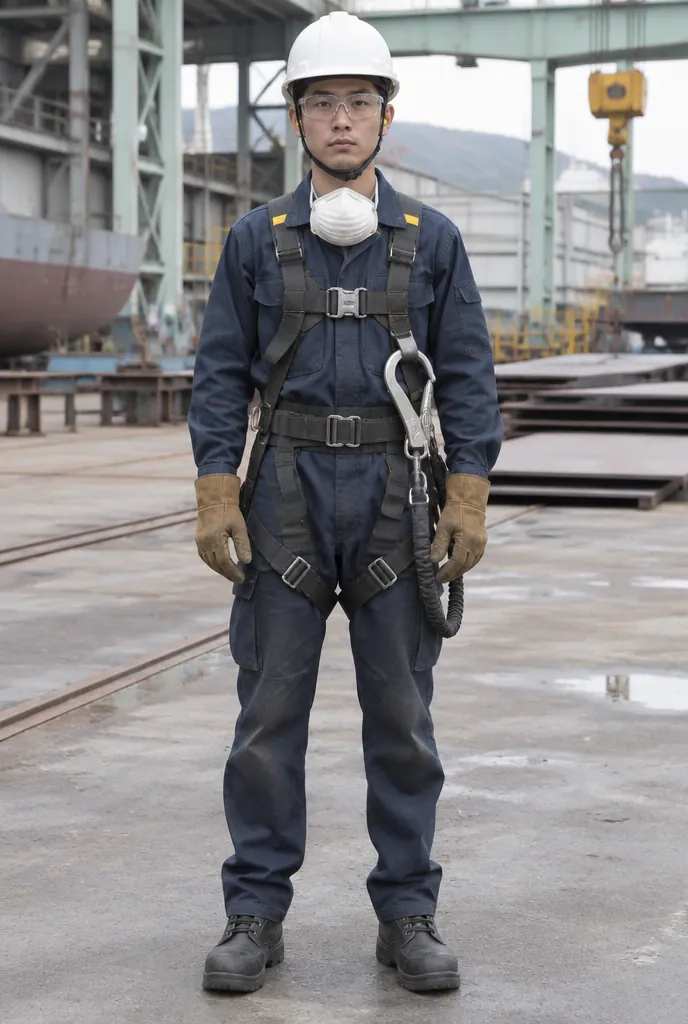
EquipmentWhat it protects / key point
Safety helmet (保護帽・ヘルメット)Head. Always fasten the chin strap
Safety shoes (安全靴)Feet. Protects your toes if something heavy falls
Safety glasses (保護めがね)Eyes. Protects from chips, sparks and paint
Full-body harness (墜落制止用器具)Prevents falling from high places. As a rule, use it at 2 m or higher
Dust mask (防じんマスク)So you do not breathe dust or welding fumes
Gas mask (防毒マスク)So you do not breathe organic solvent (thinner, etc.) gas. Check the canister type and expiry date
Earplugs / earmuffs (耳栓・イヤーマフ)Protect your ears from loud noise
Gloves (手袋)Protect your hands. But do not wear gloves with rotating machines such as drilling machines (ボール盤), because they can get caught

Check protective equipment for damage before work. Do not use damaged equipment.

Protective equipment1354872
  1. 1Safety helmet (保護帽・ヘルメット)
  2. 2Safety shoes (安全靴)
  3. 3Safety glasses (保護めがね)
  4. 4Full-body harness (墜落制止用器具)
  5. 5Dust mask (防じんマスク)
  6. 7Earplugs / earmuffs (耳栓・イヤーマフ)
  7. 8Gloves (手袋)
Protective equipmentAI-generated image

1-4Cranes and slinging

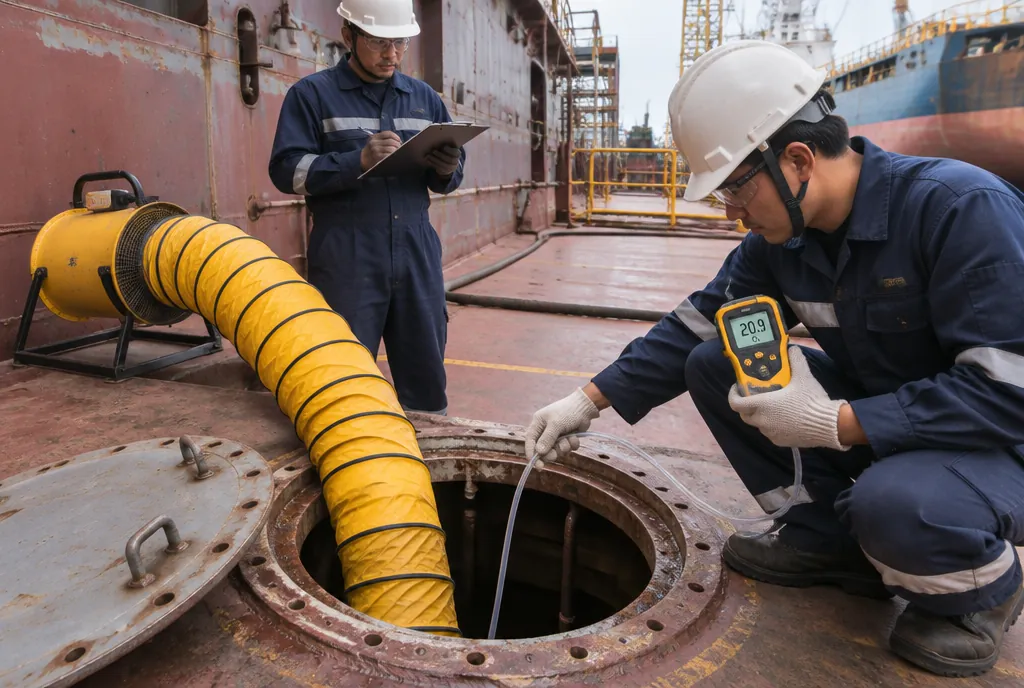
1-5High places and confined spaces

High places and confined spaces
High places and confined spacesAI-generated image
0%5%10%15%18%21%25%18%O₂ 21%O₂
High places and confined spaces

1-6Fire and explosion

1-7Electricity

1-8Hand tools and grinders

1-9Health

CHAPTER 02 / 船と造船所の基礎

Ship and shipyard basics

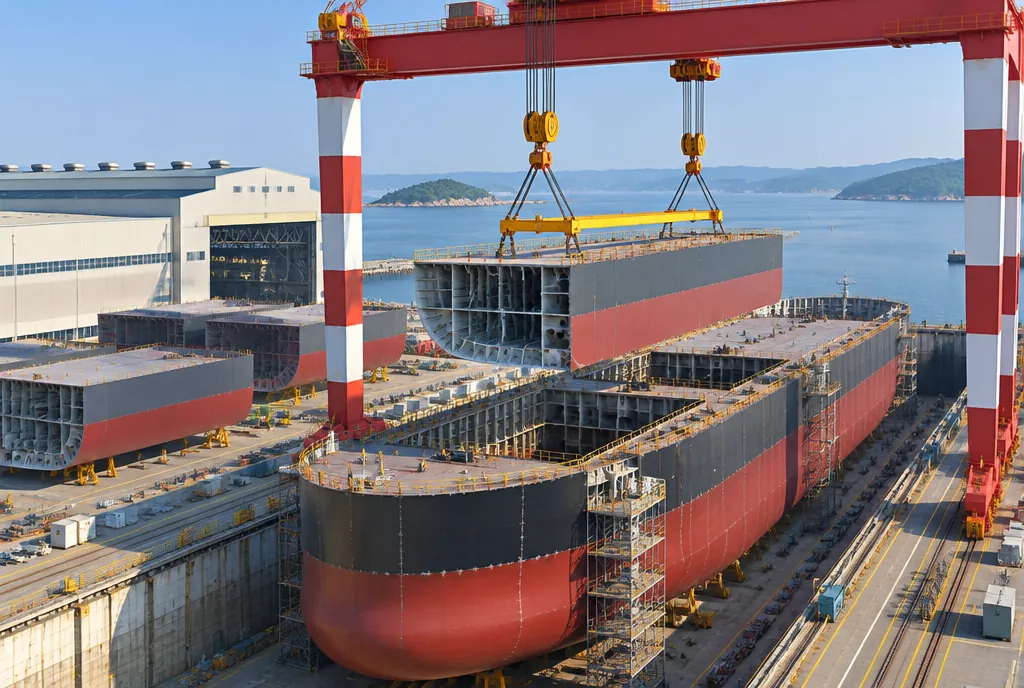
Large ships in Japan are built with the block construction method (ブロック建造法): the hull is divided into "blocks" that are joined at the end. To understand instructions at work, learn the names of ship parts and the order of the process.

2-1Names of ship parts

NameMeaning
Bow (船首)Front part of the ship
Stern (船尾)Back part of the ship
Deck (甲板・デッキ)Floor of the ship. The top one is the upper deck (上甲板)
Bottom (船底)Bottom of the ship
Double bottom (二重底)A bottom made in two layers. The space between becomes tanks
Shell plating (外板)Steel plates on the outside of the ship
Bulkhead (隔壁)Walls that divide the inside of the ship
Longitudinal (ロンジ・縦通材)Frames running along the length of the ship
Frame (フレーム・肋骨)Frames running across the width of the ship
Outfitting (艤装)Installing engines, piping, electrical systems, equipment, etc.
Engine room (機関室)Room where the engine is
Starboard / port (右舷/左舷)Right side / left side when facing forward
1234571168912PS
  1. 1Bow (船首)
  2. 2Stern (船尾)
  3. 3Deck (甲板・デッキ)
  4. 4Bottom (船底)
  5. 5Double bottom (二重底)
  6. 6Shell plating (外板)
  7. 7Bulkhead (隔壁)
  8. 8Longitudinal (ロンジ・縦通材)
  9. 9Frame (フレーム・肋骨)
  10. 11Engine room (機関室)
  11. 12Starboard / port (右舷/左舷)
Names of ship parts

2-2How a ship is built

  1. 01Design (設計) — make drawings.
  2. 02Steel processing (鋼材の加工) — marking, cutting and bending of steel plates.
  3. 03Sub-assembly (小組立) — weld members into small parts.
  4. 04Assembly (中組立・大組立) — join parts into blocks. Painting and outfitting also progress at the block stage (pre-outfitting / 先行艤装).
  5. 05Erection (搭載) — carry blocks by crane to the dock or building berth and weld them together.
  6. 06Launching (進水) — float the ship on the water.
  7. 07Outfitting (艤装) — install the remaining equipment.
  8. 08Sea trial (試運転) — check performance at sea.
  9. 09Delivery (引渡し) — hand over to the shipowner who ordered it.
How a ship is built
How a ship is builtAI-generated image

2-3Work in the shipbuilding category

In the SSW shipbuilding category (造船区分), you can do welding, painting, ironwork, scaffolding, piping and ship processing. Of these, welding, painting and ironwork are the current test job types.

2-4Drawings and units

CHAPTER 03 / 溶接

Welding

Welding joins metal by melting it with heat. In shipbuilding, arc welding (アーク溶接) — welding with the heat of an electric arc — is the main method.

3-1Types of welding

TypeFeatures
Shielded metal arc welding / manual welding (被覆アーク溶接・手溶接)Move the electrode by hand. The coating (flux) around the rod melts and protects the weld from the air. Strong against wind
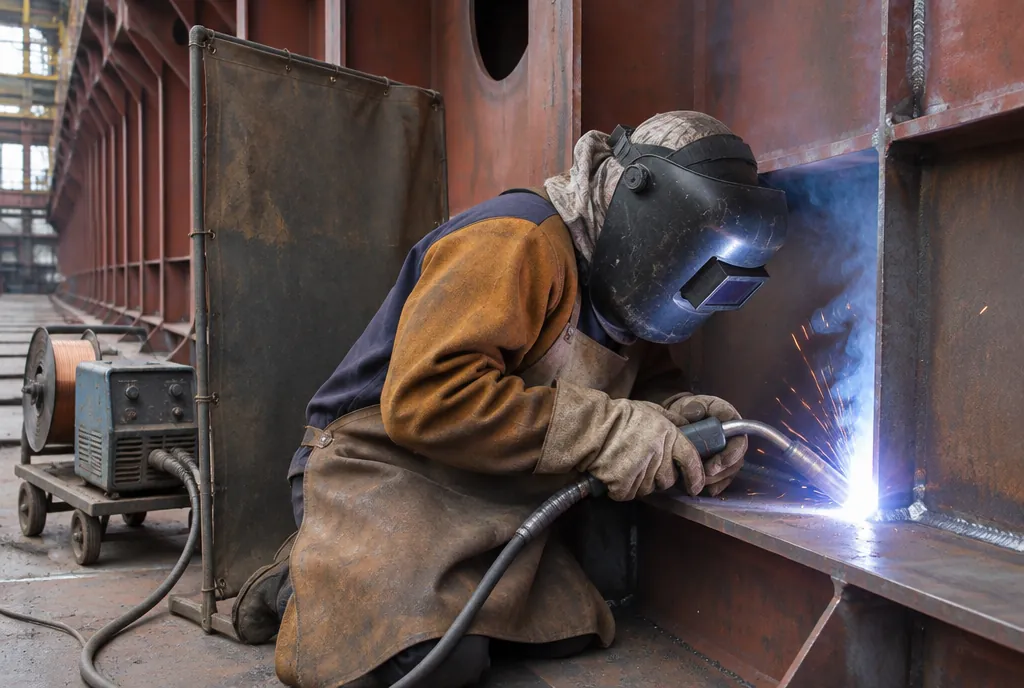
Semi-automatic arc welding (CO2 / MAG welding / 半自動アーク溶接)The wire is fed automatically. The torch is moved by hand. Shielding gas (CO2, etc.) protects the weld. Weak against wind, so use wind screens. Most common in shipbuilding
TIG welding (ティグ溶接)Uses a non-melting tungsten electrode. Protected by argon gas. Clean finish. Good for stainless steel and aluminum
Submerged arc welding (サブマージアーク溶接)Automatic welding under granular flux. Good for long straight welds. The arc cannot be seen
Types of welding
Types of weldingAI-generated image

3-2Welding positions

PositionSymbolDescription
Flat (下向)FWeld facing downward. The easiest
Horizontal (横向)HWeld sideways on a standing plate
Vertical (立向)VWeld from bottom to top (upward) or top to bottom (downward)
Overhead (上向)OWeld above your head. The most difficult
FHVO
Welding positions

3-3Joints and weld shapes

1234V½VX56
  1. 1Butt joint (突合せ継手)
  2. 2T-joint (T継手)
  3. 3Corner joint / lap joint (かど継手・重ね継手)
  4. 4Butt weld (突合せ溶接)
  5. 5Fillet weld (すみ肉溶接)
  6. 6Backing (裏当て)
Joints and weld shapes

3-4Welding defects

DefectWhat it isMain causes
Crack (割れ)A crack in the weld. The most dangerousRapid cooling, moisture, material properties
Blowhole / porosity (ブローホール・気孔)Small holes inside the weldDamp electrodes, not enough shielding gas, wind, rust or oil
Pit (ピット)Holes open at the surfaceSame as blowholes
Undercut (アンダーカット)The edge of the weld cuts into the base metal and makes a grooveCurrent too high, speed too fast
Overlap (オーバーラップ)Molten metal flows over the base metalCurrent too low, speed too slow
Slag inclusion (スラグ巻込み)Slag stays inside the weldSlag between layers was not removed
Incomplete penetration (溶込み不良)Not melted all the way to the rootCurrent too low, groove too narrow
Lack of fusion (融合不良)Base metal and weld metal are not fused wellWrong current, angle or speed
!

Fume (ヒューム, smoke from welding) and spatter (スパッタ, flying drops) are not welding defects. But fume is bad for your body, so a dust mask and ventilation are needed.

123456
  1. 1Crack (割れ)
  2. 2Blowhole / porosity (ブローホール・気孔)
  3. 3Undercut (アンダーカット)
  4. 4Overlap (オーバーラップ)
  5. 5Slag inclusion (スラグ巻込み)
  6. 6Incomplete penetration (溶込み不良)
Welding defects

3-5Preparation and points to watch

3-6Welding safety

3-7Weld inspection

InspectionMethod
Visual inspection (外観検査)Check cracks, undercut, etc. with your eyes
Bend test (曲げ試験)Bend a test piece and check for cracks
Radiographic testing (RT / 放射線透過試験)Record internal defects on film with X-rays, etc.
Ultrasonic testing (UT / 超音波探傷試験)Check internal defects with ultrasound
Magnetic particle testing (MT / 磁粉探傷試験)Find cracks near the surface with magnets and iron powder
Penetrant testing (PT / 浸透探傷試験)Find surface cracks by letting red liquid soak in

3-8Practical test (reference)

In the SSW (i) welding practical test, you weld a plate 9 mm or thicker in the flat position, butt weld, one-side weld with backing. Examiners check for cracks, blowholes, undercut, etc. with a visual test and a bend test or radiographic test.

CHAPTER 04 / 塗装

Painting

The main purpose of ship painting is to prevent rust (corrosion) from seawater. Paint quality is decided largely by "surface preparation (素地調整)".

4-1Purpose of painting

4-2Surface preparation

Before painting, remove rust, oil, moisture, dust and old paint from the surface. If surface preparation is poor, the paint soon peels off.

MethodDescription
Blasting (ブラスト)Shoot abrasive (grit, etc.) at high speed to remove rust. The cleanest result
Power tools (動力工具)Remove rust with disc sanders, wire brushes, etc.
Hand tools (手工具)Remove with scrapers and wire brushes. For partial repairs
Degreasing (脱脂)Remove oil with thinner, etc.

4-3Paint basics

4-4Painting methods

MethodFeatures
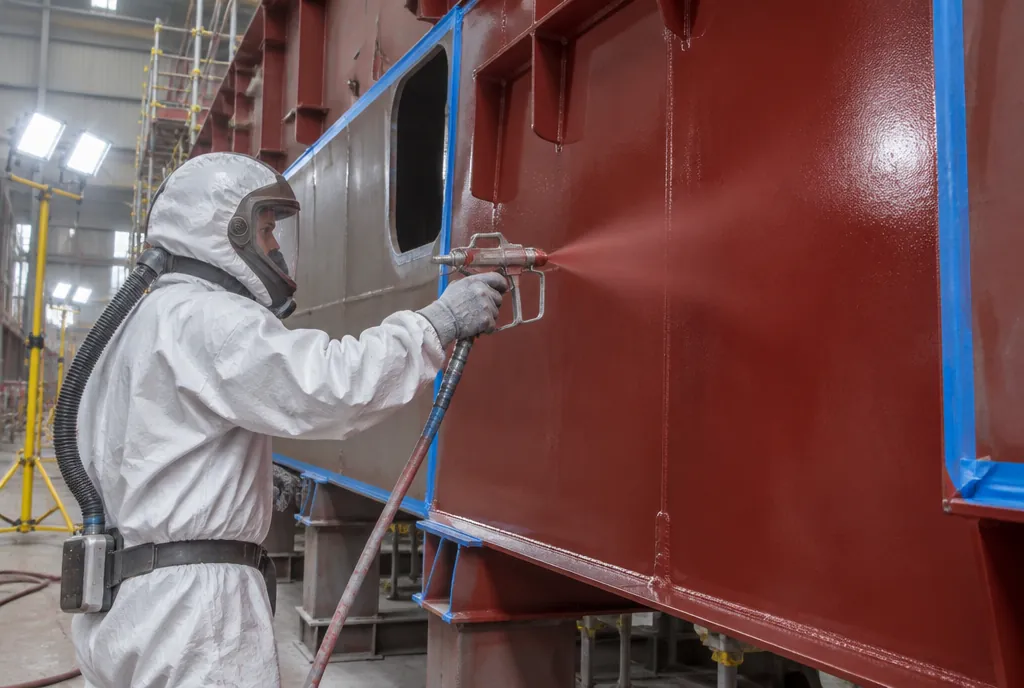
Airless spray (エアレススプレー)Puts high pressure on paint to make a mist. Paints thick and fast. Mainly used in shipbuilding
Air spray (エアスプレー)Mists paint with compressed air. Beautiful finish but much overspray
Brush (はけ塗り)For corners, welds, around bolts and other detailed parts
Roller (ローラー塗り)For wide flat surfaces
!

Spray tips: hold the gun at a right angle to the surface and move it at a constant distance and speed. Overlap each pass a little (about 1/3 to 1/2) to prevent uneven coating. Paint edges, corners and welds first with a "stripe coat (先行塗り / ストライプコート)".

Painting methods
Painting methodsAI-generated image
90°= =1/3–1/2
Painting methods

4-5Film thickness control

4-6When not to paint

%RH≥ 85%dew pointsteel≥ +3°C
When not to paint

4-7Painting defects

DefectWhat it isMain causes
Sagging (たれ)Paint runs downToo thick, thinned too much
Orange peel (ゆず肌)Bumpy like orange skinPoor atomizing, gun too far, paint too thick
Pinhole (ピンホール)Small holesSolvent bubbles, holes in the surface
Cissing (はじき)Paint is repelled and does not stickOil or moisture remains
Blushing (白化・かぶり)The film turns cloudy whiteHigh humidity
Uneven coating (塗りむら)Uneven thickness or colorGun distance and speed not constant
Peeling (はがれ)The film peels offPoor surface preparation, wrong recoat interval
12345
  1. 1Sagging (たれ)
  2. 2Orange peel (ゆず肌)
  3. 3Pinhole (ピンホール)
  4. 4Cissing (はじき)
  5. 5Blushing (白化・かぶり)
Painting defects

4-8Painting safety

4-9Practical test (reference)

In the SSW (i) painting practical test, you do surface preparation, masking and painting (airless / air / roller / brush) on a metal plate. Examiners check for no unevenness or orange peel, film thickness at or above the instruction, and no paint on masked areas.

CHAPTER 05 / 鉄工

Ironwork

Ironwork means making ship members and blocks by marking, cutting, bending and assembling steel plates and sections. Making the exact dimensions shown on the drawing is the most important thing.

5-1Marking

Marking (けがき) means drawing lines and marks on the steel surface to show where to cut and assemble.

ToolHow to use
Scriber (けがき針)Draws thin lines on the steel surface
Center punch (センターポンチ)Makes a small dent (mark) at the center of a hole or on a line
Square (スコヤ・直角定規)Checks right angles and marks them
Steel tape measure / steel rule (鋼製巻尺・直尺)Measures length
Ink line / chalk line (墨つぼ・チョークライン)Draws long straight lines
Dividers (けがきコンパス・デバイダ)Draws circles and copies the same length

Check dimensions on the drawing and measure from the reference line (基準線). Measurements shift a little each time, so always measure from the reference, not from a different place each time.

123456
  1. 1Scriber (けがき針)
  2. 2Center punch (センターポンチ)
  3. 3Square (スコヤ・直角定規)
  4. 4Steel tape measure / steel rule (鋼製巻尺・直尺)
  5. 5Ink line / chalk line (墨つぼ・チョークライン)
  6. 6Dividers (けがきコンパス・デバイダ)
Marking

5-2Gas cutting

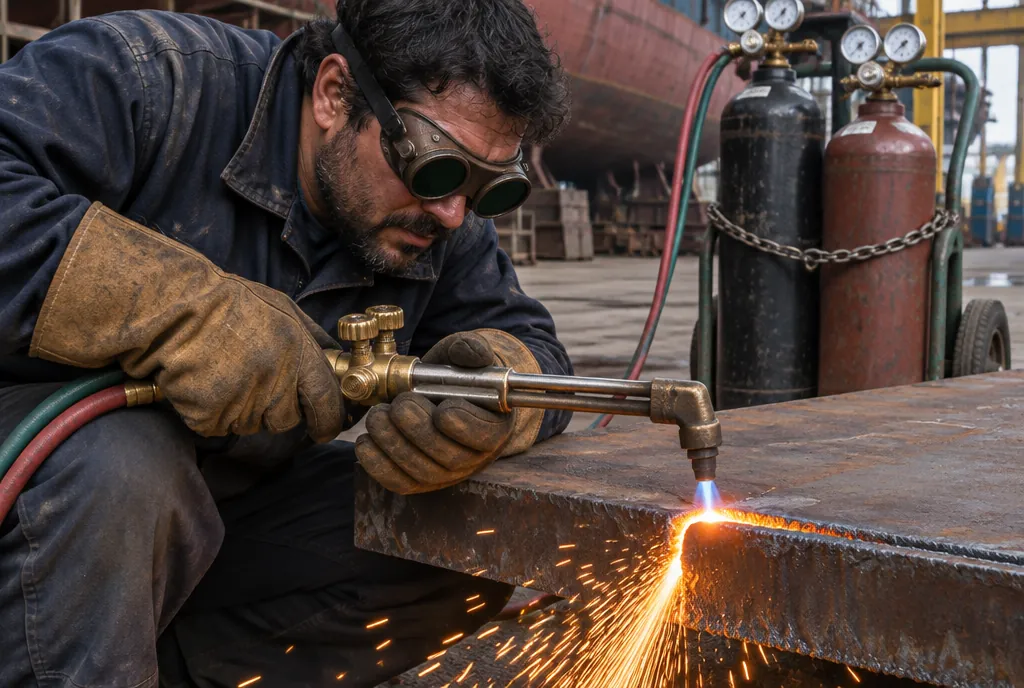
Gas cutting heats steel to its ignition temperature with a preheating flame (予熱炎), then blows high-purity oxygen onto it to burn and cut the steel.

Gas cylinder colors (Japan)

GasCylinder color
Oxygen (酸素)Black
Acetylene (アセチレン)Brown
Hydrogen (水素)Red
Liquefied carbon dioxide (液化炭酸ガス)Green
Others (argon, propane, etc.)Gray

Gas cutting safety

Gas cutting
Gas cuttingAI-generated image
12345
  1. 1Oxygen (酸素)
  2. 2Acetylene (アセチレン)
  3. 3Hydrogen (水素)
  4. 4Liquefied carbon dioxide (液化炭酸ガス)
  5. 5Others (argon, propane, etc.)
Gas cutting

5-3Bending

5-4Assembly

5-5Ironwork safety

5-6Practical test (reference)

The SSW (i) ironwork practical test is an assembly task including marking, gas cutting, bending and tack welding. Examiners check that the cut surface has no big waves, dimensions are within tolerance, tack welds do not come off, and no work was done other than instructed.

+Key terms

Safety and health (安全衛生)Preventing injury and illness安全衛生あんぜんえいせい
Protective equipment (保護具)Tools that protect the body (helmet, mask, etc.)保護具ほごぐ
Hazard prediction (危険予知)Predicting dangers before work (KY)危険きけん予知よち
Pointing and calling (指差呼称)Pointing and saying out loud to check指差呼称ゆびさしこしょう
Oxygen deficiency (酸素欠乏)Oxygen in the air below 18%酸素さんそ欠乏けつぼう
Ventilation (換気)Changing the air換気かんき
Slinging (玉掛け)Attaching wire to a crane load玉掛たまがけ
Fall (墜落)Falling from a high place墜落ついらく
No open flames (火気厳禁)Fire must not be used火気厳禁かきげんきん
Base metal (母材)The metal being welded母材ぼざい
Electrode (溶接棒)Rod used in shielded arc welding溶接ようせつ棒ぼう
Groove (開先)Channel made at plate edges for welding開先かいさき
Joint (継手)Part that connects members継手つぎて
Fillet weld (すみ肉溶接)Welding a corner in a triangular shapeすみ肉にく溶接ようせつ
Backing (裏当て)Material on the back of a butt weld裏うら当あて
Defect (欠陥)A bad part (crack, blowhole, etc.)欠陥けっかん
Shading (遮光)Blocking strong light遮光しゃこう
Preheating (予熱)Warming before welding or cutting予熱よねつ
Surface preparation (素地調整)Removing rust and oil before painting素地そじ調整ちょうせい
Film thickness (膜厚)Thickness of the paint film膜厚まくあつ
Hardener (硬化剤)Liquid mixed with the base in two-component paint硬化こうか剤ざい
Pot life (可使時間)Time mixed paint can be used可使時間かしじかん
Organic solvent (有機溶剤)Thinner, etc. Causes poisoning and burns easily有機溶剤ゆうきようざい
Dew point (露点)Temperature at which moisture in the air becomes water drops露点ろてん
Marking (けがき)Drawing cutting and assembly lines on steelけがき
Tack weld (仮付け溶接)Short weld that fixes members before main welding仮かり付つけ溶接ようせつ
Flashback (逆火)Dangerous return of the flame into the hose逆ぎゃく火ひ
Distortion (ひずみ)Steel deforming from heatひずみ
Line heating (線状加熱)Heating in lines to bend or straighten線状加熱せんじょうかねつ
Tolerance (公差)Allowed dimensional error公差こうさ

QTrue/False Questions (120)

Choose ○ if the statement is true and × if it is false.

0 / 0
  1. A-1

    If you feel unwell, keep working without telling your supervisor.

    体調たいちょうが悪わるいときは、上司じょうしに言いわずにがまんして作業さぎょうを続つづける。

  2. A-2

    You must not pass under a load lifted by a crane.

    クレーンでつった荷かの下したを通とおってはいけない。

  3. A-3

    Discussing what dangers there are before work is called KY activity.

    作業さぎょうの前まえに、どんな危険きけんがあるかを話はなし合あうことをKY活動かつどうという。

  4. A-4

    A near miss does not need to be reported because no one was hurt.

    ヒヤリハットは、けがをしていないので報告ほうこくしなくてよい。

  5. A-5

    Pointing and calling is a way to check by pointing and saying it out loud.

    指差呼称ゆびさしこしょうは、指ゆびをさして声こえに出だして確認かくにんする方法ほうほうである。

  6. A-6

    Leaving materials in passages is good because the next job can be done faster.

    通路つうろに材料ざいりょうを置おいておくと、次つぎの作業さぎょうが早はやくできるのでよい。

  7. A-7

    When working at 2 m or higher, use a full-body harness.

    高たかさ2m以上いじょうの場所ばしょで作業さぎょうするときは、墜落制止用器具ついらくせいしようきぐを使つかう。

  8. A-8

    You do not need to fasten the helmet chin strap when it is hot.

    ヘルメットのあごひもは、暑あついときはしめなくてよい。

  9. A-9

    When drilling with a drilling machine, wear gloves to protect your hands.

    ボール盤ばんで穴あなをあけるときは、手てを守まもるために手袋てぶくろをする。

  10. A-10

    Check protective equipment for damage before work.

    保護具ほごぐは、作業さぎょうの前まえにこわれていないか点検てんけんする。

  11. A-11

    Oxygen in the air below 18% is called oxygen deficiency.

    空気中くうきちゅうの酸素さんそが18%未満みまんの状態じょうたいを、酸素さんそ欠乏けつぼうという。

  12. A-12

    If someone has collapsed inside a tank, go in at once to help.

    タンクの中なかで人ひとが倒たおれていたら、すぐに中なかに入はいって助たすける。

  13. A-13

    Measure the oxygen level before entering a place where oxygen deficiency is possible.

    酸欠さんけつのおそれがある場所ばしょに入はいる前まえに、酸素濃度さんそのうどを測はかる。

  14. A-14

    Crane signals may be given by anyone nearby, by several people.

    クレーンの合図あいずは、近ちかくにいる人ひとなら何人なんにんで出だしてもよい。

  15. A-15

    Do not use wire rope with broken wires.

    素そ線せんが切きれたワイヤーロープは使つかわない。

  16. A-16

    You may pass through a no-entry area if it is a shortcut.

    立入禁止たちいりきんしの標識ひょうしきがある場所ばしょでも、近道ちかみちなら通とおってよい。

  17. A-17

    Do not put flammable things near where welding sparks fly.

    溶接ようせつの火花ひばなが飛とぶ場所ばしょの近ちかくに、燃もえやすい物ものを置おかない。

  18. A-18

    You may smoke near paint and thinner.

    塗料とりょうやシンナーの近ちかくで、たばこを吸すってもよい。

  19. A-19

    Do not touch electrical switches with wet hands.

    ぬれた手てで、電気機器でんきききのスイッチに触さわらない。

  20. A-20

    Repair machines with the power still on.

    機械きかいを修理しゅうりするときは、電源でんげんを入いれたまま行おこなう。

  21. A-21

    You may remove safety devices because they slow down work.

    安全装置あんぜんそうちは、作業さぎょうが遅おそくなるので外はずしてよい。

  22. A-22

    After changing a grinder wheel, test-run it for 3 minutes or more.

    グラインダーの砥石といしを交換こうかんしたら、3分ふん以上いじょう試運転しうんてんをする。

  23. A-23

    Stand in front of the grinder wheel when using it.

    グラインダーは、砥石といしの正面しょうめんに立たって使つかう。

  24. A-24

    To prevent heatstroke, take water and salt before you feel thirsty.

    熱中ねっちゅう症しょうを防ふせぐため、のどがかわく前まえに水分すいぶんと塩分えんぶんをとる。

  25. A-25

    Small injuries do not need to be reported.

    小ちいさなけがは、報告ほうこくしなくてよい。

  26. A-26

    If you do not know how to do a job, think by yourself and continue.

    やり方ほうがわからない作業さぎょうは、自分じぶんで考かんがえて進すすめる。

  27. A-27

    Throw tools down from the scaffold to hand them to people below.

    足場あしばの上うえから、下したの人ひとに工具こうぐを投なげて渡わたす。

  28. A-28

    5S means sort, set in order, shine, standardize and sustain.

    5Sとは、整理せいり・整頓せいとん・清掃せいそう・清潔せいけつ・しつけのことである。

  29. A-29

    Use earplugs or earmuffs in noisy places.

    大おおきな音おとがする場所ばしょでは、耳栓みみせんやイヤーマフを使つかう。

  30. A-30

    A dust mask protects against organic solvent gas.

    防ぼうじんマスクは、有機溶剤ゆうきようざいのガスを防ふせぐためのマスクである。

LABStudy Lab

Take a 30-question, 60-minute mock exam like the real test, check your weak points and review — all on this page. Your records are saved on this device.

MOCK EXAM · 30 / 60:00

Mock exam

Real test format: 30 questions, 60 minutes (10 safety + 20 job questions). Pass: 18 or more (60%).

Choose your job

Mock exam history

DIAGNOSIS

Weak point check

Find your weak areas from your correct-answer rate in each topic.

REVIEW

Review

Questions you got wrong come back until you answer them correctly 3 times in a row.

OPEN POSITION

Jobs in this field

There is a job you can apply for if you have (or will get) SSW "Shipbuilding & Marine Industry". People living outside Japan can apply too.

【特定技能・造船・舶用工業】船舶部品の塗装スタッフ岡山県玉野市 / 月給 19.7万円 / 寮あり / 完全週休2日See the job →

SOURCESSources

The technical explanations in each chapter (welding, painting, ironwork, safety) were written for this material based on general work knowledge. If your company or site has different rules, follow the site rules.